

11 Days Tour to Historic Route and Omo Valley



duration
11 days and 10 nights
Transpotation
Flight + 4W Drive
Tour Type
Group Tour, Private Tour
Group Size
2-12 people
11 Days Tour to Historic Route and Omo Valley
$110.00
Day 01 Arrival and Addis Ababa City Tour
You will meet our staff upon arrival from your international flight and after breakfast, begin your exploration of Addis Ababa with visits to some of the city’s most iconic historical, cultural, and religious sites. The day includes the following highlights:
- Entoto Maryam Church: Located on the Entoto Hills, this is one of the oldest Ethiopian Orthodox Tewahedo churches, built in 1877 by Emperor Menelik II. The church features traditional Ethiopian architecture with octagonal domes. Inside, you’ll find a collection of royal artifacts, including Emperor Menelik II and Empress Taytu’s crowns, ceremonial garments, their royal bed, and a mirror gifted to the Empress by Queen Victoria.
- Entoto Hills: At an elevation of 2,900 meters above sea level, the Entoto Hills offer a stunning panoramic view of Addis Ababa. This area, once the capital before the city moved to its current location, holds great historical and spiritual significance.
- Ethnological Museum: Situated within the main campus of Addis Ababa University, this museum is housed in the former palace of Emperor Haile Selassie. It offers a deep insight into Ethiopia’s diverse cultures, with exhibits covering anthropology, music, and traditional life. It is also recognized as the first university museum in Ethiopia.
- National Museum of Ethiopia: One of the most important museums in sub-Saharan Africa, it showcases Ethiopia’s rich archaeological heritage. Here, you will find the world-famous fossil remains of Lucy (Australopithecus afarensis), as well as Selam, a remarkably complete child hominid fossil estimated to be 3.3 million years old.
- Merkato: Conclude your day with a visit to Africa’s largest open-air market. Established during the Italian occupation in the late 1930s, Merkato spans several square miles and hosts over 7,000 businesses. It offers a dynamic experience of the city’s daily life, where you can find everything from spices and textiles to handmade crafts and electronics.
Overnight Aya Addis hotel Addis Ababa
Day 02 Fly Addis Ababa to Axum
This day after breakfast you will be taken to the airport for your flight to Axum. You will be met upon arrival and visit Axum a city more than 2500 years of history, once the center of a great empire and ancient civilization, home of the original Ark of covenants. Axum is the prime historical site in the north of Ethiopia. Take a city tour that includes:-
The Church of Saint Mary of Zion and the religious complex the sanctuary Chapel which is the repository of the ‘Ark of covenant’
The coronation yard, Stele Park
Tomb of Kaleb and his son Gebre Meskel
Ezana’s Inscriptions
Queen of Sheba’s Bath, Queen of Sheba’s palace ruins and Axum Museum, Later drive to airport your flight to Addis Ababa.
Overnight Sabean Hotel Axum
Day 03 Fly Axum to Arba Minch via Addis Ababa
This day after breakfast you will be taken to the airport for your connection flight to Arba Minch via Addis Ababa. You will be met upon arrival and drive to
Dorze people who are expert in weaving called Shammas Weaving are a primary profession for a number of Dorze people. The shape of their house looks Elephant, in order to remember the existence of these animals around the area many years ago. They are known for their traditional weaving of huts made out of local bamboo. Enset “fake banana” is the stable food for these peoples.
Overnight Haile Resort Arba Minch
Day 04 Drive Arba Minch – Konso – Turmi
After having your breakfast you will take a boat cruise on the
Lake Chamo, the third biggest Lake in Ethiopia you will have a boat trip to see the crocodiles, hippos & aquatic bird species. The northern shores of Lake Chamo are famous for its large crocodiles, which can be seen in numbers lounging in the heat. The lake is about 32km long and provides a lush wetland habitat for many species of flora and fauna. Visit and proceed southwards to
Konso village, one of the UNESCO site in Ethiopia know by their terracing in order to protect against soil erosion from the sporadic and often heavy rainfall in the region. The villages are encircled by one to six concentric rings of stone walls, mainly consisting of basalt boulders. The age of each town is classified by a generation pole and each family lives in compounds that are accessible only through gateways that require the visitor to enter on all fours thereby rendering any potential attackers vulnerable. One of the best types of coffee for the country is also from this village. Later drive to Turmi.
Overnight Paradise Lodge in Turmi
Day 05 Drive Turmi -Kangaten (Nyangatom tribe) — Karo tribe – Turmi
This morning, we continue through the savannah with shrubs and umbrella acacia trees.
Kangaten (Nyangatom tribe) To adore their long and lean bodies, the Nyangatom women wear numerous necklaces and long Skirts from goatskins that are richly decorated They are indeed fierce warriors which is supposedly demonstrated by their custom to scar their chest; one scar for each killed enemy. Herds of cows are their most valuable property. Later drive to Kolcho, the village of
Karo people at the eastern bank of Omo River with beautiful views, Karo are famous for their intricate face and body painting practices, which they apply on their heads and torso before major events and on the weekly markets. Karo is the smallest tribes of the Omo Valley and Karo men also sculpts and shave their hair into extravagant shapes, with special ochre “caps” of hair usually containing several ostrich feathers. Then back to turmi for lunch and proceed to the
Hamer people, distinguished by the fact that their women wear leather skirts decorated with shells, wear several copper bracelets on their hands and heavy iron necklaces around their necks, symbolizing their social status, and their hair is colored with ocher and animal fat. Men, in case of victory over the enemy or a dangerous beast, fix the hairstyle with clay and decorate with ostrich feathers. This hairstyle is carefully guarded the Hamar sleep with a special borkotos chair under their neck. they are also known for their unique custom of “bull jumping,” which initiates a boy into manhood, practice of body adornment and wearing a multitude of colorful beads.
Overnight Paradise Lodge in Turmi
Day 06 Drive Turmi – Omorate – Jinka
After breakfast you will drive to Omorate crosses the Omo River to visit the Dassanech tribe only 72 Km from Turmi, Dassanech are traditional pastoralists, but in recent years began to move to a semi-nomadic way of life. The highest expression of male beauty is the vulgar transverse scars across the entire chest and back, resembling crocodile skin. Such scars are inflicted on a body of the warrior who showed himself heroically in battle, who killed the enemy in course of tribal cattle raids.
Overnight Eco Omo Lodge
Day 07 Visit Ari Village and Fly to Addis Ababa
After breakfast at the hotel you will visit
Ari people, the largest population in the lower omo valley, their traditional territory stretches from the northern edge of Mago National Park to the highland areas around Jinka and Key Afer, The women wear skirts from the banana like tree, called Enset are expert in pottery, blacksmith and distillation of traditional Liquor. After lunch you will drive to airport your flight to Addis Ababa.
Overnight Aya Addis hotel Addis Ababa
Day 08 Fly Addis Ababa to Gondar
This day after breakfast you will be taken to the airport for your flight to Gondar. You will be met upon arrival and begin your visit to the Royal Capital of Ethiopia. Gondar was founded in 1636 by Emperor Fasiledes
Castle of Gondar Because of its historical importance and architecture, the fortress was inscribed as a UNESCO World Heritage Site in 1979. The complex of buildings includes Fasilides’ castle, Iyasu I’s palace, Dawit III’s Hall, Empress Mentewab’s castle, a chancellery and library from Yohannes I, a banqueting hall from the emperor Bakaffa.
Debre Birhan Selassie (The Enlightening of Trinity) It was founded in the late 17th century by Iyasu I, but the building had to be rebuilt after fire and lightning. Most other churches in Gondar were destroyed by the Dervish of Sudan; Debre Birhan Selassie escaped because it was protected by brave bees. The walls contain biblical stories, depicting several scenes of the life of Christ and various saints. Some of the scenes are brutal, beheadings are depicted with bloody detail, and the devil also made it to the colorful walls.
Fasiledes Bath is a significant historical and cultural site in Gondar. It’s a square Embattlement pool with a two storied palace situated within and it plays a crucial role in the celebration of Epiphany, the Timkat festival. The compounds walls have been slowly engulfed by the thick slithering roots of ancient badian trees that are now intertwined with the crumbling brickwork.
Overnight Haile Resort Gondar
Day 09 Fly Gondar to Lalibela
After breakfast you will be taken to the airport for your flight to Lalibela. You will be met upon arrival and taken to your Hotel. After lunch you will Visit
Bete Golgotha‑Mika’el: a twin‑church complex marking the most sacred area, featuring the Selassie Chapel within Bete Golgotha said to house the tomb of King Lalibela and striking carved reliefs of saints inside Bete Mika’el
Bete Maryam: possibly the oldest church in the site, with an intricately painted ceiling depicting biblical scenes and windows symbolizing the Trinity and crucifixion
Bete Meskel: a small chapel carved into the courtyard of Bete Maryam, the “House of the Cross”
Bete Denagel (House of the Virgins): an intimate, grotto‑like chapel adjacent to Bete Maryam, reputed to commemorate fifty Christian nuns martyred in late antiquity
Bete Medhane Alem: the largest free‑standing monolithic church in the world, shaped like a Greek temple. Inside, dozens of columns support the vaulted ceiling, and the polished stone floor reflects shafts of light from high‑aperture windows. In one corner stand three symbolic empty graves for the patriarchs Abraham, Isaac, and Jacob. Later in the afternoon, you’ll visit the western group’s standalone masterpiece:
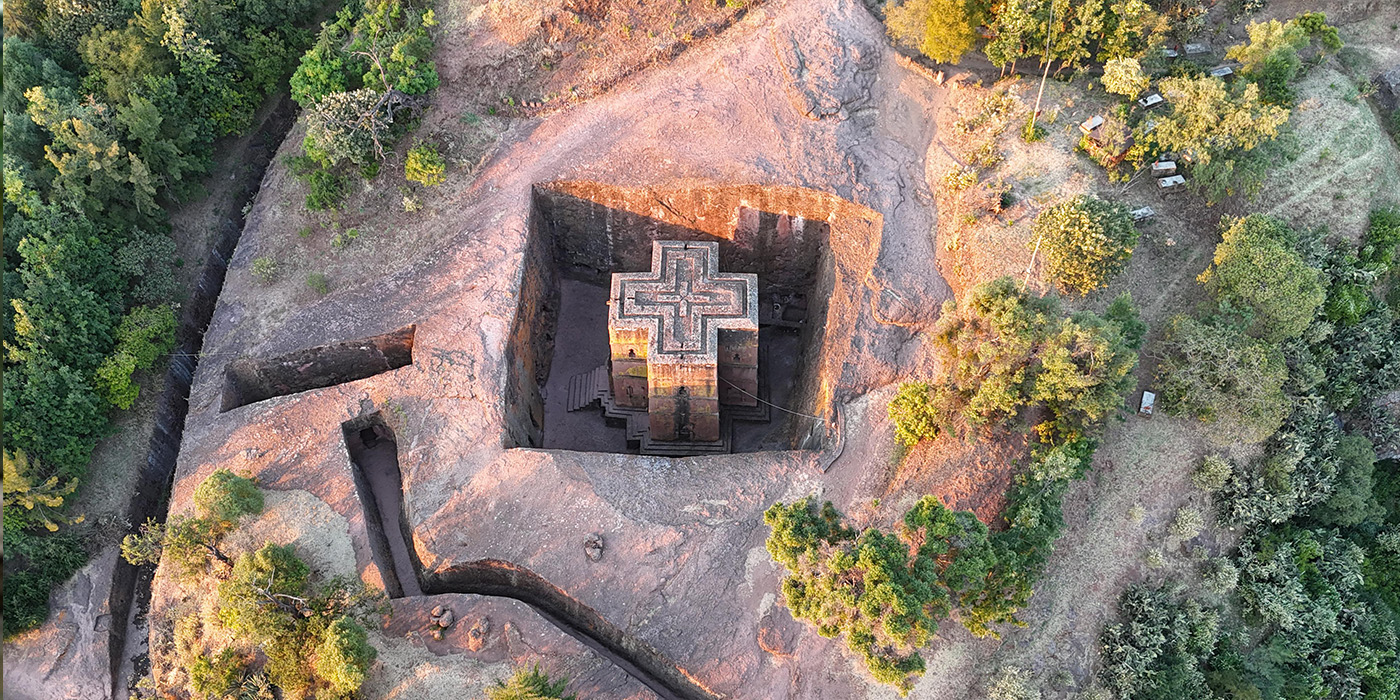
Bete Giyorgis (Church of Saint George): isolated on a sloping rock terrace to the southwest of the village, this church is carved in the shape of a perfect cross and often considered the most elegant of all 11. It stands in a sunken pit and is reached via tunnels and trenches
Overnight Maribela Hotel Lalibela
Day 10 Drive Lalibela to Asheten Maryam and Na’akuto La’ab
After breakfast, you’ll journey to
Na’akuto La’ab Monastery founded by Na’akuto La’ab, the successor of King Lalibela. Inside, you’ll discover a fascinating collection of sacred artifacts believed to have belonged to Na’akuto La’ab himself: crowns, gold-painted drums, ornate crosses, a large painted canvas featuring ancient monarchs, and an illuminated Bible of remarkable beauty. Of particular interest are the ancient stone basins that collect water dripping from the cave’s roof widely regarded as holy.
Afterwards, you’ll drive on to
Asheton Maryam Church, another longstanding sanctuary packed with sacred treasures. Here, the priest graciously displays a collection of intricate crosses and a richly illustrated Bible, showcasing colorful and elaborate artworks that date back centuries.
Overnight Maribela Hotel Lalibela
Day 11 Fly Lalibela to Addis Ababa
After breakfast, you’ll spend the morning exploring the remaining rock hewn churches of Lalibela like:-
- Bete Gabriel‑Rufael (House of Archangels Gabriel and Raphael)
- Bete Marqorios (St. Mercurius/Mark the Evangelist)
- Bete Emmanuel (House of Emmanuel)
- Bete Abba Libanos (House of Abbot Libanos)
These southeastern cluster churches, carved into volcanic rock, showcase exceptional Aksumite architectural features and intricate decorative motifs unique to Lalibela, After visiting these sacred sites, you’ll be transferred to Lalibela Airport to catch your flight back to Addis Ababa. You will be met upon arrival and at the evening Attend a folkloric dinner featuring a variety of traditional Ethiopian dishes. Enjoy captivating performances from Ethiopia’s diverse ethnic groups as they dance and sing. Cap off the evening with the authentic traditional coffee ceremony, a foundational cultural rite in Ethiopia. Finally you will be taken to the airport for your international flight.
Included
- All entrance fees
- Bottled Water
- 4W Drive vehicle with Driver and Fuel
- Professional Guide Service
Excluded
- Personal expenses (e.g., souvenirs, snacks)
- Tips and gratuities
- Optional activities or excursions
- Alcoholic Drinks
- Video and Camera Charges
Cancellation Policy
At Aman Ethiopia Tour & Travel, we strive to provide flexibility and customer satisfaction. Our cancellation and booking policy combines standard, promotional, and flexible options to ensure a seamless experience for our clients.
Show moreQuestions?
We’re here to help! If you have any inquiries about our tours, destinations, or custom packages, feel free to get in touch with us.
Product code: 35388
Contact usRelated products
-

-
- Adventure and Safari
9 Days Danakil Depression with Northern Ethiopia Tours
Group Tour
From $2,100.00/Person9 days
- $2,100.00
- View Details
-
-


-
- Customized
6-Day Bishoftu Lakeside Escape: Relaxation & Wellness at Ethiopia’s Premier Resorts
Private Tour
From $1,200.00/Person6 Days
- $1,200.00
- View Details
-
-

-
- Southern Ethiopia
8 Days Southern Omo Valley, Lalibela and Danakil Depression Tours
Group Tour
Request for Price8 Days and 7 Nights
- $0.00
- View Details
-